The Complete BJJ Gi Buying Guide for New Zealand
Fit, fabric, GSM, weaves, competition rules and enough gi terminology to make buying what is essentially a very tough pair of pyjamas strangely complicated.
Buying a BJJ gi gets complicated surprisingly quickly. Fit, fabric, weave, weight and competition rules can all matter, and the right choice for a first class is not always the same one you would make for a tournament. This BJJ Gi Buying Guide walks through the details that actually affect how a gi feels, fits and performs, with practical advice for New Zealand grapplers buying their first gi or replacing one that has seen better days.
Choose Your Next Gi Guide
Already know what you need help with? Jump straight to the most useful Go Getter Gi guide.

- The Complete BJJ Gi Buying Guide for New Zealand
- Choose Your Next Gi Guide
- History of Grappling and the Evolution of the BJJ Gi
- Ancient Origins of Grappling
- Medieval to Early-Modern Grappling
- The Roots in Judo and Jigoro Kano
- Mitsuyo Maeda (Count Koma)
- The Birth of Brazilian Jiu-Jitsu (1914–1930s)
- Expansion of Gracie Schools (1950s–1980s)
- Non-Gracie Lineages: Fadda, França, and Beyond
- Modern Major Schools & Lineages
- How It All Fits Together
- BJJ Enters the Global Stage
- Contemporary Grappling and the Future
- The Purpose of the Gi in Modern Training
- Gi vs. No-Gi Training
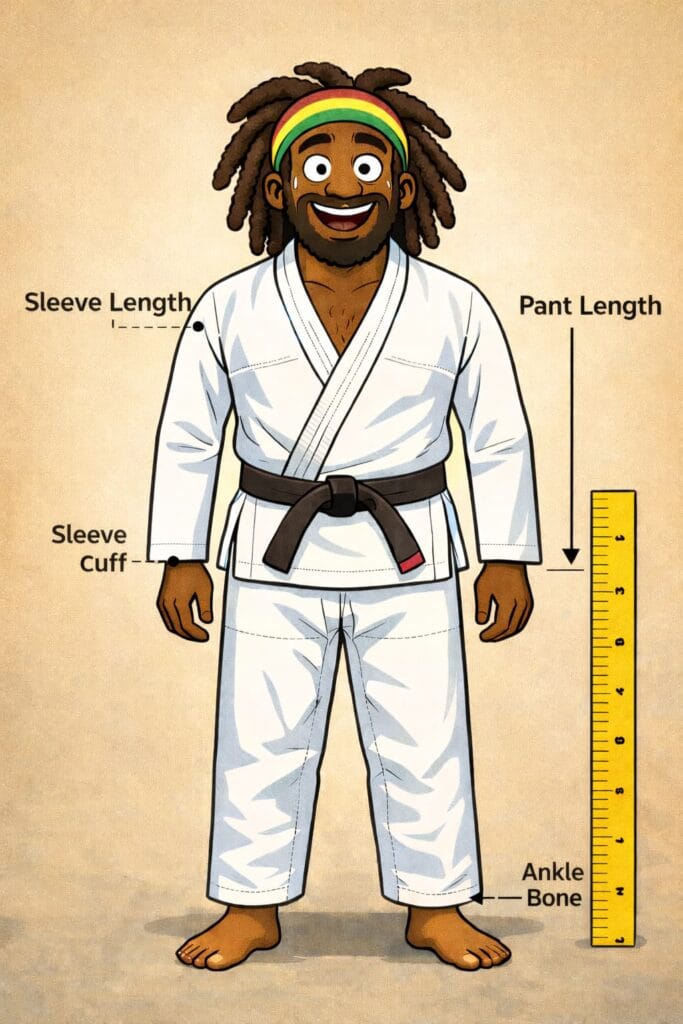
- Anatomy of a BJJ Gi
- Finding the Best BJJ Gi in New Zealand – The Complete Buyer’s Guide
- Legacy Gi Sizing (Old A-Series, F/W, and M/K/Y/C Charts)
- IBJJF and UAEJJF (AJP) Rules and Competition Legality
- Best BJJ Gis for Different Needs
- How to Care for Your BJJ Gi
- FAQs About BJJ Gis
- Final Thoughts — Choosing the Right Gi for You
History of Grappling and the Evolution of the BJJ Gi

From ancient scraps to modern super-camps — here’s how we went from wrestling in the dirt to arguing about lapel grips on a Tuesday night in Auckland.
Ancient Origins of Grappling
Grappling is older than your coach’s favourite dad joke. Long before anyone worried about IBJJF sleeve checks, people were tossing each other around for sport, status, and the odd festival brag.
Across cultures, wrestling shows up in art, myth, and ritual. In Egypt (3000–2000 BCE), tomb paintings lay out more than 200 distinct moves — throws, clinches, joint locks — the same fundamentals you’ll recognise when some white belt tries an Americana from the wrong side. In ancient Greece, wrestling was the Olympic darling. Milo of Croton won six times, allegedly training by carrying a calf every day until it was a bull — which is one way to build grips, I guess.
Rome nicked Greek wrestling (as Rome did) and blended it with gladiatorial theatre, pushing technique toward both spectacle and ruthless efficiency. Meanwhile, other local styles grew roots of their own:
- Sumo (Japan): codified between the 3rd–8th centuries CE, born from Shinto ritual contests.
- Kushti (India): Hindu–Islamic training culture in akharas (wrestling pits), strict diet, serious conditioning.
- Shuai Jiao (China): recorded as early as the Tang dynasty (618–907 CE), a jacket-wrestling system with military purpose.
Side note: The common thread? Clothing changes combat. If there’s a sash, belt, or jacket, you’ve got a handle — and a whole new game opens up.
In short: Humans love a good wrestle, and the moment we added a jacket, the seeds of Judo and BJJ were planted.
Medieval to Early-Modern Grappling

Japan’s feudal years produced jūjutsu — not a single style, but a family of schools built for armoured warriors who didn’t have time for flowery nonsense. The Takenouchi-ryū school (1500s) is one of the earliest, favouring short strikes, joint locks, and throws designed to finish quickly — like trying to sweep someone who’s wearing a steel fridge.
Europe kept its own flavours simmering: Cornish wrestling in England, Bökh in Mongolia, glíma in Iceland. But the big influence for no-gi submission grappling was 19th-century British catch-as-catch-can. It was carnival-tent chaos with pins and “hooks” (submissions), exported to America, then forked into two branches: professional wrestling (the show) and the technical roots that feed modern no-gi.
In short: East and West both refined ways to handle someone in armour or wool. By the time the modern era arrived, the toolbox was well stocked.
The Roots in Judo and Jigoro Kano
By the late 1800s, Japan wanted to modernise its martial traditions. Enter Jigoro Kano (1860–1938), a scholar who blended Tenjin Shin’yō-ryū and Kitō-ryū into something tidy, testable, and teachable: Judo. In 1882 he founded the Kodokan in Tokyo with a handful of students and a truckload of ideas:
- Randori: live training over rote memorisation — technique that works under pressure.
- Safety: rules and breakfalls so you could train hard and still show up to work on Monday.
- Education: “maximum efficiency, mutual welfare” — Judo as character building, not just arm-yanking.
Kano also formalised the judogi: reinforced cotton jacket and pants, coloured belts for rank. That uniform is the direct ancestor of today’s BJJ gi.
In short: Kano gave us a safer, smarter way to test grappling — and the uniform to do it in.

Mitsuyo Maeda (Count Koma)
Among Kano’s students, Mitsuyo Maeda (1878–1941) — “Count Koma” — specialised in newaza (groundwork) and took the show on the road. From 1904–1914 he toured the world — the U.S., U.K., Spain, Mexico, Cuba — doing demos, challenge matches, and teaching wherever people were keen (or cocky).
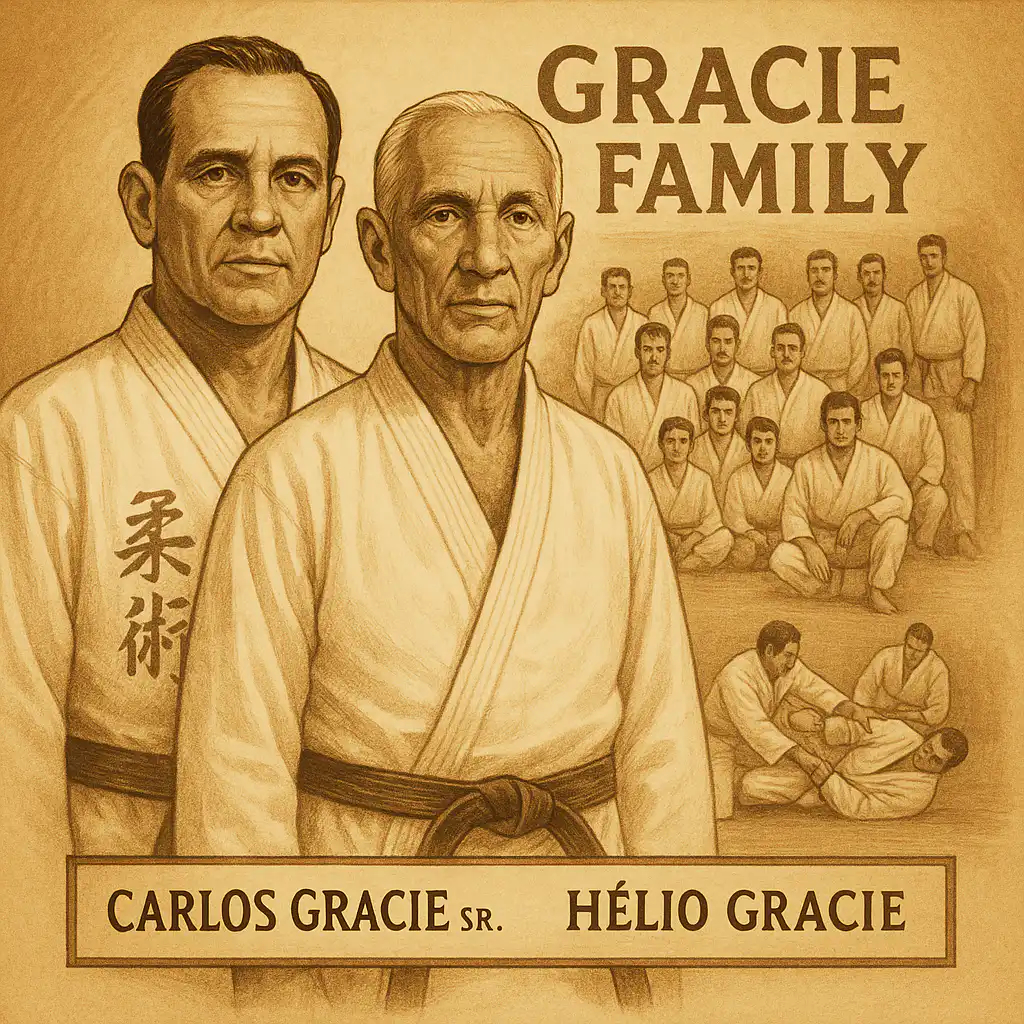
In 1914, Maeda landed in Brazil, settled in Belém do Pará, and taught locals — including a young Carlos Gracie. Through Carlos and his brother Hélio, Judo’s groundwork would evolve into something new.
Kiwi aside: Imagine explaining closed guard to a Victorian strongman. “So you just… wrap your legs around them and wait?” Yep. And it works.
In short: Maeda spread the gospel of practical grappling. Brazil listened — closely.

The Birth of Brazilian Jiu-Jitsu (1914–1930s)
- 1914: Maeda begins teaching in Brazil.
- 1920s–30s: Carlos and Hélio Gracie experiment and adapt for smaller frames — leverage, guard positions, efficiency.
- Early innovations: closed guard, open guard, and a clear positional hierarchy (mount, back control, side control).
The gi at this stage was basically a judogi tuned for Brazil’s heat: slimmer sleeves, reinforced pants, lighter weaves. Over time, the “BJJ gi” found its own cut and feel.
In short: Same jacket, different philosophy — BJJ leaned into the ground with precision and patience.
Expansion of Gracie Schools (1950s–1980s)
The Gracie Family Tree and Lineages (1930s–2000s)
BJJ and the Gracie family are practically braided together. Different branches built gyms, teams, and ideas — some focused on competition, others on self-defence and lifestyle. To understand modern teams like Alliance, Atos, or Checkmat, it helps to see where the roots spread.
The First Generation: Carlos & Hélio Gracie
- Carlos Gracie Sr. (1902–1994): Maeda’s student; opened early Gracie academies, emphasised diet, philosophy, and jiu-jitsu as a way of life.
- Hélio Gracie (1913–2009): Smaller frame, huge impact — refined leverage and efficiency, became the family’s public fighter in early challenges.
The Second Generation: Expansion and Divergence
- Carlson Gracie (1932–2006): Competition and vale tudo focus; his students later formed Brazilian Top Team (1997) and American Top Team (2001).
- Carlos Gracie Jr. (b. 1956): Founded Gracie Barra (1986) and the IBJJF (1994) — massive global influence.
- Rilion Gracie (b. 1960): Renowned guard player and teacher; spread the family’s technical style far and wide.
- Rickson Gracie (b. 1958): Technical icon; “invisible jiu-jitsu” — posture, breath, unseen mechanics. His son Kron carried the torch in comp and MMA.
- Rorion Gracie (b. 1952): Co-founded the Gracie Academy in the U.S.; launched the UFC in 1993.
- Relson Gracie (b. 1953): Based in Hawaii; strong self-defence emphasis across the Pacific.
- Rolls Gracie (1951–1982): Visionary cross-trainer (judo, wrestling, sambo); mentor to Romero “Jacaré” Cavalcanti — a seed for Alliance.
The Third Generation: Competitors and Global Builders
- Renzo Gracie (b. 1967): Founded Renzo Gracie Academy (NYC, 1996); produced John Danaher and, eventually, the DDS lineage.
- Roger Gracie (b. 1981): 10x IBJJF World Champion; pillar of BJJ in the UK/Europe.
- Kron Gracie (b. 1988): ADCC 2013 champion; carried Rickson’s legacy into MMA.
- Clark Gracie (b. 1984): “Omoplata King”; popularised submission-centric training for everyday practitioners.
- Carley Gracie (b. 1950): Early U.S. pioneer (San Francisco).
Other Influential Gracies
- Royce Gracie (b. 1966): UFC 1, 2, 4 winner — put BJJ on every gym’s whiteboard.
- Gracie Miami / Valente Brothers: Preserved Hélio’s self-defence curriculum in Florida.
- Gracie Humaitá (1952): Still led by Hélio’s family — balance of tradition and modern competition.
Expansion of Schools (1950s–1980s)
- Gracie Humaitá (1952): Rio; produced Rickson, Royler, and Rolker Gracie.
- Carlson Gracie Academy (1960s; formalised 1968): Copacabana; aggressive, team-first culture; later seeded BTT and ATT.
- Gracie Barra (1986): Carlos Jr.’s systematised instruction and branded identity; now 700+ affiliates worldwide.
In short: The family tree branched into schools, systems, and later — super-teams. The art got structure, not just stories.
Non-Gracie Lineages: Fadda, França, and Beyond
Not every road runs through the Gracies. Luis França, another Maeda student, taught Oswaldo Fadda (1915–2005), whose academy championed accessibility and footlocks — techniques the Gracies famously side-eyed for years.
- GFTeam (1990s): Led by Julio Cesar Pereira.
- Nova União (1995): André Pederneiras and Wendell Alexander; produced BJ Penn, José Aldo, and a stack of world champs.
In short: Parallel lineages broadened the toolkit — proving BJJ is bigger than one surname.
Modern Major Schools & Lineages
By the 1990s, BJJ grew beyond family academies into a global sport. The IBJJF (1994) built a consistent ruleset; the first Mundials (1996) gave everyone a world stage. Out of this came the teams that shaped the modern meta:
- Alliance (1993): Romero “Jacaré” Cavalcanti; stars like Marcelo Garcia, Cobrinha, Lucas Lepri; a dynasty of team titles and technical innovation.
- Brasa (2002): Born from Alliance splits; incubated Demian Maia, Robert Drysdale, Felipe Costa; short-lived, massive impact.
- Checkmat (2008): Vieira brothers; aggressive passing; home of Buchecha.
- Atos (2008): André Galvão & Ramon Lemos; berimbolo era through to modern monsters (Mendes bros, Kaynan, Ruotolos).
- AOJ (2012): Mendes brothers’ precision school; youth-to-black-belt pipeline (Tainan Dalpra, Cole Abate, Jessa Khan).
- Cobrinha BJJ (2010s): Alliance LA powerhouse; feather/lightweight excellence.
- Unity (2015): Murilo Santana’s NYC hub; magnet for elite lightweights.
- Ribeiro Jiu-Jitsu (2002): Saulo & Xande; fundamentals and longevity.
- Renzo Gracie Academy (1996): Danaher think-tank; MMA crossover (GSP, Serra) and no-gi revolution (DDS).
- 10th Planet (2003): Eddie Bravo; no-gi only; rubber guard/lockdown/twister systems.
- Machado Brothers (1990s): Early North American ambassadors.
- ZR Team (2000s): Zé Radiola; rapid European expansion.
- Cicero Costha PSLPB (2000s): Scholarship model; produced Leandro Lo and the Miyaos.
- Dream Art (2018): Isaque Bahiense; pro-style athlete support, like an Olympic programme.
- Fight Sports (2011): Cyborg; no-gi firepower.
- Legion AJJ (2020): Keenan Cornelius; lapel-guard R&D and athlete-led branding.
- Absolute MMA (2010s): Melbourne; Lachlan Giles’ ADCC 2019 run; Oceania on the map.
- Pedigo Submission Fighting / Daisy Fresh (2010s): Heath Pedigo; blue-collar grind to world-class results.
In short: From Rio neighbourhoods to global networks — competition hardened styles, and styles created dynasties.
How It All Fits Together
By the late 2010s, BJJ wasn’t dominated by a couple of Rio postcodes anymore. Innovation spread everywhere: lapel guards, leg-lock systems, wrestling integrations, structured athlete development — each camp adding pieces to the puzzle. The sport professionalised; the culture diversified.
In short: Decentralisation = innovation. Everyone pushes everyone — even the crew rolling in a cold gym in Christchurch.
BJJ Enters the Global Stage
1993: Royce Gracie wins UFC 1 and shocks the martial arts world.
1998: The first ADCC kicks off. Open rules, cash prizes, global trials — the “Olympics of Grappling.”
Today, ADCC trials hit every region: North America, South America, Europe, Asia & Oceania, and emerging circuits in the Middle East & Africa. That structure surfaces talent from everywhere — Kazakhstan to Auckland — and accelerates global growth.
In short: The cage proved the point; ADCC built the playground.
Contemporary Grappling and the Future
Contemporary Grappling Networks
The old “one HQ with affiliates” model is evolving. Professional events, athlete-driven super-camps, and global mobility created a new ecosystem where learning travels fast — often via YouTube the same night a technique debuts.
In short: Less top-down, more cross-pollination. Your game updates as fast as your Wi-Fi.
The Danaher Era and Its Legacy
John Danaher’s systematic approach to leg locks and positional control rewired no-gi. The DDS era (Gordon Ryan, Garry Tonon, Eddie Cummings, Nicky Ryan) showed what a unified system can do at scale. The 2021 split birthed two Austin giants:
- New Wave Jiu-Jitsu: Danaher & Gordon — methodical dominance and ADCC prep.
- B-Team: Craig Jones & crew — creative, entertaining, open-mat culture.
Together they turned Austin into no-gi’s global capital — with a ripple effect felt all the way in Kiwi gyms.
In short: Systems win — but there’s room for mischief. (Very Kiwi.)
Oceania’s Emergence
Australia and New Zealand aren’t just “far away” anymore — they’re producing world-class talent and ideas. Absolute MMA (Melbourne) and Lachlan Giles’ ADCC 2019 run put a spotlight on Oceania’s technical depth. ADCC trials now feed directly from the region, and Kiwi mats are busier — and better — for it.
In short: From Tāmaki to Te Waipounamu, the scene’s legit — not just rugby and a cheeky roll after work.
Expanding Asian Hubs
Japan’s Carpe Diem and Axis keep producing technicians (Rikako Yuasa, Kenta Iwamoto). Southeast Asia’s on the rise too — Singapore, the Philippines, Thailand — boosted by ADCC trials and regional promotions. Travel with a belt and you’ll never struggle to find a friendly mat and a tough round.
In short: Asia’s depth is growing fast — and the styles are wonderfully different.
Central Asia and the Middle East
Kazakhstan and Kyrgyzstan blend sambo, judo, and BJJ with serious wrestling heritage. The UAE’s investment through UAEJJF/AJP (including BJJ in schools) is building a generation that treats grappling like a full-time career from childhood.
In short: Institutional backing + wrestling cultures = scary good athletes.
The Decentralized Future
The power map’s changed: Austin for no-gi systems, Oceania for innovation, Japan/SEA for technical expansion, Central Asia for wrestling fusion, UAE for infrastructure. No single capital can gatekeep the gi — or no-gi.
Reality check: The best idea wins — not the loudest gym. Even if the loudest gym is on Instagram.
In short: The sport’s future is multi-hub, multi-style, and moving quickly.
The Craig Jones Invitational and the Future
Craig Jones Invitational (CJI) launched in 2024 with $1M prize pools, then levelled up again in 2025. It’s athlete-first, media-savvy, and global — showcasing talent from Oceania, SEA, Japan, Central Asia, Europe, and the Americas. Whatever you think of the promo, the signal is clear: professional grappling is here to stay.
- Expect hybrid rulesets — wrestling, sambo, and BJJ blending constantly.
- More athlete-run events, fewer top-down gatekeepers.
- Regional powerhouses rival the traditional Brazil/U.S. axis.
And through it all, the gi remains central — the rank system’s anchor, the tradition we wear, the uniform that ties BJJ back to Kano’s Kodokan, even as no-gi soaks up the bright lights.
In short: The show’s getting bigger, the money’s getting real, and the gi still matters — on the podium and on a quiet Wednesday class with your crew.

The Purpose of the Gi in Modern Training
More than just a uniform — the gi is the heartbeat of traditional BJJ. It slows things down, sharpens your technique, and keeps the art connected to its roots. You can’t really understand Brazilian Jiu-Jitsu without understanding what that jacket actually does for your game.
Technical Purpose: Grips, Friction, and Control
Unlike no-gi, where everyone’s slipping around in rash guards and boardies, the gi turns the whole thing into a chess match. The jacket, pants, and thick collar add friction — suddenly every sleeve, lapel, and seam becomes a weapon. That’s how you get the classics: cross-collar chokes, spider guard, worm guard, and a dozen other setups that only make sense once you’ve got fabric to hang onto.
This friction slows the roll and changes the tempo. Gi matches are usually more methodical, where a few centimetres of grip placement can decide whether your guard pass flies or flops. The lapel grip isn’t just about holding on — it forces you to use timing, leverage, and patience instead of brute strength. That’s why even most no-gi specialists started off in the gi — it’s the school that teaches control.
Real talk: You can deadlift all you like, but if someone wraps your sleeve and ties you in a knot, that’s technique over testosterone every time.
A Platform for Technical Development
Training in the gi builds the kind of habits and body awareness that carry straight into no-gi or MMA. Breaking grips, defending collar chokes, managing posture — all that gives you balance and composure when things get slippery later. That’s why so many coaches still tell beginners to start with a gi before venturing into the spandex jungle.
The gi also shaped the evolution of guard play itself. Without it, you don’t get the berimbolo, the lapel guard, or the signature collar-sleeve systems the Mendes brothers perfected. And without those, you probably don’t get the Ruotolos running wild in modern comps. The fabric built the framework — the athletes just kept finding new ways to use it.
In short: The gi makes you slow down, think, and learn the invisible stuff — the pressure, posture, and micro-timing that separate hobbyists from technicians.
Cultural and Traditional Significance
The gi isn’t just gear — it’s the thread that ties us back to judo and old-school Japanese jūjutsu. Wearing it shows respect for the art, your training partners, and the lineage you’re a part of. Most gyms won’t let you roll in a crusty, ripped jacket for good reason: it’s about discipline, not dress code.
Competition bodies back that up:
- IBJJF: allows only white, blue, or black gis, with strict rules on length, patch placement, and collar thickness.
- AJP / UAEJJF: similar standards, but they also introduced rank-specific coloured gis for some team events — like purple belts wearing purple gis. Bit flash, aye.
- Both: inspect uniforms before every match. Fail the check, and you’re off the mats before the first grip.
This obsession with uniformity keeps things fair. It reminds everyone that BJJ is about skill, not who has the flashiest tailor.
The Gi as an Educational Tool
For beginners, the gi is a strict but fair teacher. A lazy grip slips, a loose drawstring comes undone, and that open collar you forgot to defend? That’s your cue to tap. Every detail counts. It builds awareness the hard way — through trial, sweat, and the occasional ego check.
For higher belts, the gi becomes a laboratory. Every grip is a variable, every fold a possible setup. The more you experiment, the deeper the rabbit hole goes. That’s why gi matches often expose a grappler’s technical depth more clearly than no-gi — there’s no hiding behind speed or chaos when your lapel’s tied around your own arm.
Think of it like this: No-gi shows how athletic you are. The gi shows how smart you are. Both matter — just in different languages.
Symbolism in Modern BJJ
These days, the gi’s also an expression of identity. Teams like Gracie Barra, Alliance, and Atos built global brands around clean, consistent uniforms. At the same time, personalisation exploded — pearl-weave jackets, ripstop pants, eco-friendly hemp blends, and limited-run team patches. It’s not just about function anymore; it’s culture, fashion, and pride stitched together.
Even as no-gi grows through ADCC and super-fights, the gi remains the visual symbol of BJJ worldwide. Walk into any gym from Auckland to Abu Dhabi — that rack of freshly washed gis hanging up front tells you you’re in the right place.
Why the Gi Still Matters
In an era dominated by leg-locks and heel-hook highlights, the gi still anchors the art. Most of the greats — Buchecha, Tainan Dalpra, Roger Gracie — built their reputations wearing it. Even legends of the no-gi scene like Craig Jones and Gordon Ryan spent years in the gi first, learning the principles that make their game airtight today.
The gi survives because it teaches things you can’t fake: patience, precision, strategy, and respect. Whether you’re chasing gold at IBJJF Worlds, flying to an AJP Grand Slam, or just rolling with your mates after mahi, the gi keeps you honest. It’s not just what we wear — it’s how we learn.
“In a world of shortcuts, the gi still makes you earn it — one grip at a time.”
Gi vs. No-Gi Training
Every gym’s got the great debate — gi or no-gi? At the end of the day, they’re two sides of the same jiu-jitsu coin. One’s the traditional chess match, the other’s the high-speed drift race. Both have their place on Kiwi mats.

Differences in Techniques, Grips, Pace, and Competitive Emphasis
Brazilian Jiu-Jitsu comes in two main flavours. Gi training slows everything down with friction — sleeves, lapels, and pant grips become your steering wheel. Every fold of fabric is a handle, every grip a potential trap. No-gi strips all that away. Suddenly, it’s underhooks, body locks, and head control doing the work. The pace jumps, the scrambles multiply, and wrestling takes centre stage.
In comps, you can see the split instantly: IBJJF matches are tactical, positional, and all about grip warfare, while ADCC or WNO shows move at double speed — faster transitions, bigger risks, and heavy submission hunting. Same art, different tempo. Both demand intelligence; they just speak different dialects.
Local insight: One night you’re fighting for a lapel in your gi class — next night, you’re slipping out of body locks in no-gi. Either way, someone’s trying to choke you before work tomorrow.
How Gi Training Develops Precision, Control, and Technical Refinement
Training in the gi forces you to mind the details. The fabric’s friction acts like resistance training for your technique — if your grip’s weak or timing’s off, the gi exposes it straight away. There’s no muscling your way out; you’ve got to be efficient and deliberate. This environment rewards posture, leverage, and patience. It’s a slow cooker for skill.
That’s why athletes who start in the gi often bring sharper mechanics into no-gi or MMA. They’ve learned to feel tension through cloth, anticipate balance shifts, and control space. Managing collars and sleeves builds discipline that carries through even when there’s no fabric to grab. The gi doesn’t make you slower — it makes you cleaner.
Why Cross-Training in Both Styles Creates More Complete Athletes
The best in the world don’t pick sides — they train both. The gi teaches structure, timing, and defensive awareness; no-gi sharpens reaction speed, athleticism, and adaptability. Modern pros like Nicholas Meregali, Gordon Ryan, and Mikey Musumeci have shown how combining both worlds builds the most complete game.
For everyday Kiwis on the mats, it’s the same deal. Mix your weeks — gi classes for focus and finesse, no-gi for intensity and cardio. That balance turns casual grapplers into problem-solvers who can handle any pace, ruleset, or opponent that steps through the door.
Gi for brains. No-gi for reflexes. Do both, and you’ll roll smarter, faster, and longer — with fewer excuses on Monday morning.
Anatomy of a BJJ Gi
The humble gi has come a long way from stiff judo kimonos and scratchy canvas. These days, every stitch, weave, and collar choice tells you something about how we train, where we train, and how hot the gym gets in midsummer down in Aotearoa.

The Jacket — Historical Evolution, Weave Types, GSM Ranges, Collar Design, and Reinforcements
The gi jacket — or kimono top — has evolved from thick, armour-like judo uniforms into purpose-built tools for movement, comfort, and strength. Its fabric weight is measured in GSM (grams per square metre):
- 600–900 GSM: traditional heavy uniforms — bullet-proof but hot, best for old-school grinders or cold winter mornings in Dunedin.
- 400–500 GSM: the modern sweet spot; 450 GSM is now the performance benchmark — strong enough for competition, light enough to breathe.
- 275–350 GSM: ultralight travel or summer gis — trades stiffness for comfort and dries fast after class.
Weave styles range from pearl to gold, honeycomb, hybrid, and new aero-weaves — each balancing weight, feel, and tear resistance. Collars are usually reinforced with EVA foam or rubber cores so they hold shape and don’t soak up sweat like a sponge. Key stress points — armpits, cuffs, and side vents — use triple or even quadruple stitching to stop early blow-outs.
Tip for Kiwi rollers: if your gi’s heavier than your surfboard bag, you’re wearing the wrong weave for summer.
The Pants — Fabric Options, Ounce Ranges, Drawstrings, and Waist Systems
Pants are measured in ounces (oz) per square yard — not GSM — but the idea’s the same: heavier equals tougher. Common specs are:
- 8–9 oz: lightweight twill or ripstop; ideal for hot climates and competition weight-cuts.
- 10–12 oz: mid-weight blends balancing comfort and durability — what most of us train in year-round.
- 14 oz +: old-school canvas; great if you enjoy sweating like you’re in a sauna.
Modern gi pants now play with cotton-poly blends, canvas, or sateen finishes for flexibility and feel. Rope-style drawstrings run through six or more reinforced loops, often capped with rubber or silicone tips. Double-layered knees and shaped panels help them last longer through takedown drills and knee-slide wars.
Stitching, Panels, Seam Tape, and Linings — The Shift Toward Lightweight Durability
Top-tier gis aren’t just one big sheet of fabric anymore. They’re a patchwork of carefully shaped panels that spread tension and resist tearing. Many include custom seam tape — branded, patterned, or inspired by local culture — and some add sublimated rash-guard linings for moisture control and a bit of flair when you open the jacket.
This marks a real turning point in gi manufacturing: we’re no longer chasing density, we’re chasing efficiency. Newer weaves give you strength without the weight, quick-drying performance, and just enough flex to move naturally under pressure. It’s smart engineering disguised as tradition.
Competition Legality Preview — IBJJF/AJP Standards Versus Modern Lifestyle and Non-Competition Gis
Uniform rules have deep roots in the sport’s growth. The IBJJF model — heavily shaped by Gracie Barra — focused on conformity: only white, blue, or black gis allowed, with exact sleeve lengths, collar thickness, and approved patch zones. The AJP / UAEJJF follows similar guidelines, adding their own rank-based colour schemes for team events.
But as BJJ spread globally, the mats started to look a lot more colourful. Most of us train for lifestyle, fitness, and culture, not just medals — and our gear shows it. Non-competition gis under 350 GSM or in colours like navy, army green, sand, maroon, and lavender are common. Some academies even design custom seam tape or inner linings that reflect their community’s story.
Reality check: the IBJJF might hate your camo gi, but your local club probably loves it — as long as it’s clean and doesn’t smell like a boot.
While federations still police uniforms for sanctioned events, day-to-day training has become a space for expression. The gi isn’t just fight gear anymore; it’s part of your identity — a blend of culture, comfort, and creativity stitched together with a bit of history.
Finding the Best BJJ Gi in New Zealand – The Complete Buyer’s Guide
Choosing a gi in Aotearoa isn’t as simple as grabbing the first one off the rack at Rebel Sport. A gi isn’t just a uniform — it’s your training tool, sweat sponge, and sometimes your opponent’s favourite handle. From IBJJF sleeve checks to how cotton shrinks in humid Auckland summers, every detail counts.
Whether you’re after your first affordable starter, a light comp gi for travel, or a premium hemp blend that’ll outlast your belt, here’s how to size, compare fabrics, and shop smart for Kiwi conditions.

OEM vs ODM (How Gis Are Made)
- OEM – Original Equipment Manufacturer: You (or the brand) design everything — cut, material, seam tape, artwork — and the factory just builds it. It’s the long road but gives total control and consistency.
- ODM – Original Design Manufacturer: You pick from the factory’s existing patterns and slap on your logos and colours. Faster, cheaper, less freedom. Great for clubs ordering team uniforms or new brands testing ideas.
OEM = custom craftsmanship. ODM = smart shortcut. Know which you’re buying — it tells you how that gi’s stitched, how it fits, and how long it’ll survive your next open-mat.
Legacy Gi Sizing (Old A-Series, F/W, and M/K/Y/C Charts)
Note: These are our legacy sizing systems kept here for reference only.
For our official, up-to-date size charts for kids, youth, women, and adults, please visit our full BJJ Gi Size Guide NZ — the one-stop guide for all current Go-Getter Gi sizing.
Adult Gi Sizes (A0 – A6 + Husky & Lanky Variants)
| Code | Height (cm) | Weight (kg) | Description |
|---|---|---|---|
| A0 | 155–165 | 50–60 | Petite adults / teens |
| A0L | 160–170 | 50–65 | Tall & lean |
| A1 | 165–175 | 60–75 | Average adult |
| A1L | 170–180 | 60–80 | Lanky / long-limbed |
| A1H | 165–175 | 75–85 | Broad / husky |
| A2 | 175–185 | 75–90 | Standard athletic frame |
| A2L | 180–190 | 75–95 | Tall / slim |
| A2H | 170–180 | 90–105 | Stocky / muscular |
| A3 | 185–195 | 90–105 | Large build |
| A3L | 190–200 | 90–110 | Extra-tall |
| A3H | 180–190 | 105–120 | Power-heavy |
| A4+ | 195 + | 105 + | Custom / extended builds |
Women’s Gi Sizes (F / W 0–5 + L / S Variants)
| Code | Height (cm) | Weight (kg) | Description |
|---|---|---|---|
| F0 / W0 | 145–155 | 40–50 | Petite |
| F1 / W1 | 150–160 | 45–55 | Slim athletic |
| F2 / W2 | 160–165 | 50–60 | Average build |
| F3 / W3 | 165–170 | 55–70 | Taller athlete |
| F4 / W4 | 170–180 | 65–80 | Extended tall |
| F5 / W5 | 175–185 | 75–90 | Broad / plus fit |
Kids and Youth Gi Sizes (M / K / Y Series)
Elastic waists for Minis; rope drawstrings for Youth. Choose durability over “room to grow” — too-baggy gis fail IBJJF checks.
| Code | Height (cm) | Age | Notes |
|---|---|---|---|
| M0000 | 95–105 | 3–4 | Starter gi / elastic waist |
| M00 | 110–120 | 5–6 | Wider cut for growth |
| M1 / K2 | 130–140 | 7–8 | Reinforced knees |
| Y3 / K4 | 140–150 | 9–11 | Common comp size |
| Y5 / C4 | 155–165 | 12–14 | Final youth before A0 |
Weight and GSM Ranges
- Ultralight (275–350 GSM): Best year-round. Cool for summer, easy for travel or weigh-ins.
- Lightweight (350–450 GSM): Great balance.
- Mid-weight (450–550 GSM): Built for daily rollers.
- Heavy (550 GSM +): Traditional tanks — grip-resistant but hot as Rotorua steam baths.
Gi Weave Types
- Single Weave: Entry level, light, affordable.
- Double Weave: Dense, nearly ungrabbable, but cooks you alive.
- Gold Weave: Classic hybrid — strong + breathable.
- Pearl Weave: Modern standard; IBJJF-legal and reliable.
- Hybrid / Aero / Honeycomb: Lighter, branded upgrades of pearl.
- Hemp / Bamboo: Eco-friendly, soft, antimicrobial — future-proof fabric.
Gi Pant Fabrics & Weaves
- Cotton Drill (10 oz): Traditional and tough.
- Ripstop (8 oz): Light nylon-cotton grid; dries fast.
- Canvas (12 oz +): Heavy duty, stiff, near-indestructible.
- Hemp / Bamboo Blends: Eco-friendly, breathable, naturally odour-resistant.
Fabric Materials
- 100 % Cotton: Classic comfort, minor shrink.
- Poly-Cotton Blends: Shrink-resistant and quick-drying.
- Hemp / Bamboo: Sustainable, antimicrobial, long-wearing.
- Recycled Blends: New wave eco options made from recovered fibres.
Construction Details & Quality Checks
- Stitching Density: 3× = standard, 4× = comp-grade, 6× = tank mode.
- Panel Design: Fewer seams = lighter; more panels = stronger fit.
- Lapel Core: EVA foam = standard; rubber = stiff defence.
- Pant Reinforcements: Double knees and gussets are a must.
- Waist Systems: Rope drawstrings rule; flat is old-school.
Durability & Shrinkage
| Material | Shrink % | Breathability | Dry Time | Durability | Notes |
|---|---|---|---|---|---|
| 100 % Cotton | 2–4 (Pre) / 5–10 (Raw) | High | Medium | High | Classic feel but tightens hot-washed. |
| Poly-Cotton (50–65 %) | 1–3 | Med–Low | Fast | High | Less shrink, less airflow. |
| Hemp 100 % | 2–5 | Med–High | Medium | Very High | Softens over time; antimicrobial. |
| Bamboo 100 % | 2–4 | High | Fast | Medium | Cool in humid gyms. |
Kiwi care tips: Wash cold (≤30 °C), line-dry, reshape while damp, rotate your gis so each fully dries between classes.
Price Ranges (NZD)
- Entry $100 – $180: Single weave or poly-cotton; ideal for beginners.
- Mid-Range $180 – $280: Pearl weave + ripstop pants = best value for Kiwi rollers.
- Premium $280 – $450 +: Hemp / bamboo, eco lines, limited editions, custom team kits.
TL;DR — Industry Standard Gi Template
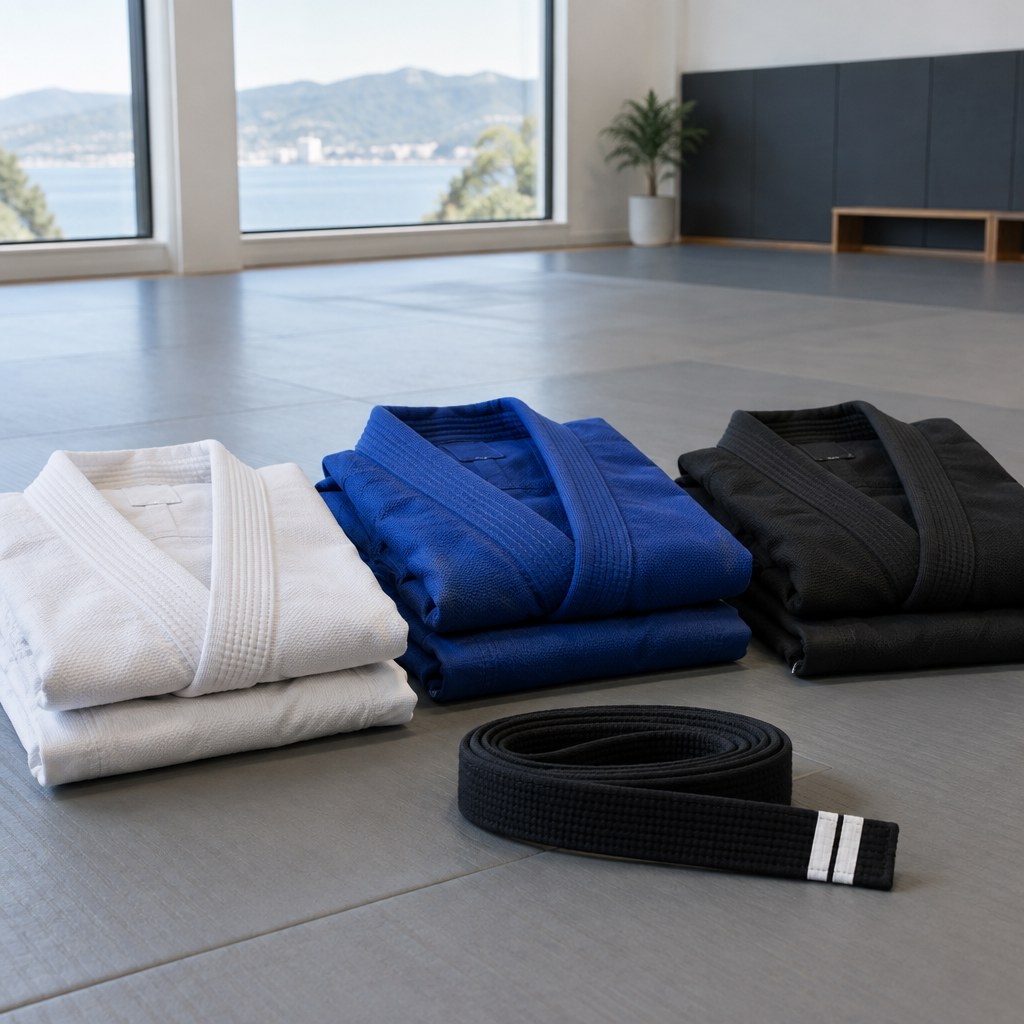
Pearl weave (400 GSM cotton or cotton-poly), EVA foam lapel, 10 oz ripstop pants with rope drawstring, double knees, cotton seam tape, pre-shrunk, IBJJF-legal in white / blue / black.
In Summary
- Hot NZ summer → 275–450 GSM pearl weave natural fibre (or poly-blend depending on budget).
- Cold winter → poly or hemp blend for quick dry and warmth.
- Daily rollers → pre-shrunk cotton + reinforced pants.
- Competitors → check IBJJF / AJP rules before weigh-ins.
- Eco types → bamboo or hemp options are the future.
Bottom line: A gi that fits your body and climate isn’t just clothing — it’s gear for growth. Train hard, wash cold, hang dry, repeat.
IBJJF and UAEJJF (AJP) Rules and Competition Legality
If you’re a Kiwi grappler eyeing the podium at Abu Dhabi or Pan Pacs, you’ll want to make sure your gi actually makes it past the uniform check. The IBJJF and AJP have some of the most pedantic referees in the business — tape measures, calipers, the works. Knowing the rules now saves the awkward “sorry bro, you can’t wear that” moment later.
While you can train in anything from navy hemp to camo bamboo, competition gis must meet strict standards for colour, measurements, branding, and presentation. Here’s what matters if you plan to compete internationally from Aotearoa.
Approved Colours (IBJJF vs UAEJJF Rules)
IBJJF-Approved Gi Colours
- White – HEX #FFFFFF (Pure White)
- Royal Blue – HEX #002366 (similar to Pantone 293 C)
- Black – HEX #000000
The IBJJF allows only these three colours. Jacket, pants, and lapel must all match. Mixed sets (white top / blue pants) are instant DQ. Patches have to contrast clearly with the fabric — no stealth black-on-black branding.
AJP / UAEJJF-Approved Gi Colours
Same core trio — white, royal blue, black — but certain team or rank-based events allow exceptions, such as purple belts wearing purple gis. These are event-specific only.
Official Rulebooks (no-follow):
Sleeve, Pant, and Collar Measurements
Both federations check gis before your first match — sometimes more than once. Bring a backup gi if you’re unsure.
IBJJF Key Measurements
- Sleeve Opening: ≥ 7 cm gap from arm when extended.
- Pant Cuff Opening: ≥ 5 cm gap from leg when extended.
- Jacket Skirt: Must cover the glutes.
- Collar Width: 4 – 5 cm.
- Collar Thickness: ≤ 1.3 cm.
- Sleeve & Pant Length: No shorter than 5 cm above wrist or ankle standing upright.
AJP / UAEJJF Key Measurements
- Mirrors IBJJF specs but adds stricter checks on jacket width and sleeve taper at major events.
- Too-tight jackets can still fail even if they technically fit IBJJF limits.
Fail the inspection once, you usually get one chance to swap gis — then it’s a walk back to the crowd.
Patch and Branding Regulations
IBJJF Rules
- Patches must be flat-stitched with no peeling edges.
- Allowed zones: shoulders, upper arms, chest, upper back, pant thighs, and shins.
- Not allowed: lapels, inside jackets, or outside pant cuffs.
- Team or brand logos OK; unrelated ads may be rejected.
- No patches used to cover holes or reinforce tears.
AJP / UAEJJF Rules
- Mostly identical placement standards but more forgiving for pro divisions.
- Sponsor logos must still contrast and be flat-stitched.
- Top events (e.g., Grand Slams or World Pro) may require official AJP patches before weigh-in.
Tip for NZ competitors: Get your custom patch layout checked against the IBJJF diagram before you sew or embroider — saves you from mid-comp scissor snips by the inspectors.
Additional UAEJJF / AJP Rules (Rashguards, Brand Restrictions, Presentation)
- Rashguards: Mandatory for women; optional for men but must match belt rank if worn.
- Clean & Pressed: No stains, rips, or funk. They’ll literally sniff check if needed.
- Brand Approval: Certain elite events restrict gear to AJP-recognised brands.
- No Metal or Plastic Ends: Drawstrings must be soft; no zips, buttons, or metal aglets.
Competition-Legal Quick Check Summary
| Specification | IBJJF | UAEJJF / AJP |
|---|---|---|
| Allowed Colours | White, Royal Blue, Black | Same (+ rank-specific exceptions) |
| Lapel Core | EVA foam, ≤ 1.3 cm | Same |
| Sleeve Gap | ≥ 7 cm | ≥ 7 cm |
| Pant Gap | ≥ 5 cm | ≥ 5 cm |
| Patches | Strict zones / flat-stitched | Slightly more flexible |
| Rashguard | Optional (men) / Required (women) | Rank-specific / Required (women) |
| Brand Limits | Open (academy / sponsor only) | AJP-recognised brands at elite events |
In Summary
The safest bet for NZ athletes is simple:
- White, royal blue, or black pearl-weave gi (350–450 GSM)
- EVA foam lapel ≤ 1.3 cm thick
- 10 oz ripstop or drill pants with rope drawstring
- Clean patch zones / flat-stitched logos / no extras
Even if you train in flash custom gis during the week, owning one competition-legal uniform keeps you ready for anything — from local Auckland opens to the Abu Dhabi World Pro. Train smart, pack two gis, and keep one that passes the tape measure test.
Best BJJ Gis for Different Needs
The “best” gi depends on what you’re up to — first class, daily grind, or chasing medals. Priorities change (weight, feel, durability), but the goal stays the same: pick a gi that matches your training volume, NZ climate, and mat goals. Easy as.
Best Gis for Beginners
If you’re new to rolling, you want comfort, easy care, and gear that won’t quit after a month of collar drags.
- Jacket: ~280 GSM pearl weave — light for learning, tough for drilling.
- Pants: 8 oz twill — softer than ripstop, kinder on skin during long classes.
- Fabric blend: 50/50 cotton–poly (or bamboo/hemp blend) — cuts shrinkage, dries faster in humid Kiwi summers, keeps shape.
- Collar: rubber core — premium feel, holds structure longer than standard EVA.
- Non-negotiable: wash after every session — the gym will thank you; your gi will last longer.
TL;DR: Lightweight, pre-shrunk, breathable, and comfy — that’s the beginner sweet spot.
Best Lightweight Gis (Training & Travel)
Going for “feather on the scales, steel on the mats”? Modern lightweights have you sorted.
- Jacket: ~280 GSM pearl with reinforced stress points.
- Pants: 8 oz twill for breathability and comfort; dries overnight on the motel shower rail.
- Collar: rubber core — slightly heavier feel, but firmer grips and better shape retention.
- Total weight (A2): around 1.2 kg — miles lighter than old judo tanks (2.0–2.5 kg).
Feels more like a hoodie than a canvas jacket — perfect for sticky Auckland gyms or throwing in the carry-on. With modern weaves and dense stitching, a 280 GSM jacket can last years without feeling like a sauna suit.
Best Competition Gis
Make weight, pass inspection, and stay hard to hang onto.
- Jacket: 350–450 GSM pearl — balance of structure and speed.
- Pants: 10 oz drill — tougher knees, reliable under pressure.
- Collar: EVA for lighter weigh-ins or rubber for shape over a long day.
- Cut: slim sleeves, tapered pants, triple-stitched stress zones — harder to grip, easier to pass.
- Compliance: check IBJJF/AJP sleeve & pant lengths, collar thickness, and patch zones before comp day.
Best Women’s Gis
Same performance fabrics as unisex models, but with tailoring that actually fits.
- Jacket: ~280 GSM pearl with narrower shoulders and tapered torso.
- Pants: 8 oz twill with a higher rise for comfort and mobility.
- Collar: rubber core — stays crisp after frequent washing.
- Why: washes easy, dries fast, holds shape — ideal if you’re training multiple times a week.
Best Kids’ Gis
Keep it comfy, simple, and tough — less faff, more fun.
- Jacket: 275–350 GSM pearl for natural movement.
- Pants: twill with reinforced knees (so they survive breakfalls and school bags).
- Waist: elastic for Minis; rope drawstring for Youth sizes.
- Fabric: poly-cotton blends resist shrinkage; easier on parents’ laundry schedules.
- Fit tip: size by height, not age — and wash after every class.
Eco-Friendly Options (Hemp, Bamboo, Recycled)
If sustainability’s your thing, these fabrics punch above their weight:
- Hemp: thick, antimicrobial, almost shrink-proof; softens beautifully over time.
- Bamboo blends: cool, soft, sustainable; great for humid gyms.
- Recycled/organic blends: lower footprint with solid durability.
Usually pricier upfront, but they resist odour and often outlast budget cotton.
In Summary
The most balanced modern spec — equally good for beginners, daily rollers, and weekend competitors:
- Jacket: ~280 GSM pearl (50/50 cotton–poly or bamboo/hemp blend)
- Pants: 8 oz twill with reinforced knees
- Collar: rubber core
- Finish: pre-shrunk, wash cold, line-dry
Breathable, durable, quick-drying, and competition-friendly when you need it — a new gold standard for BJJ in Aotearoa and beyond.
How to Care for Your BJJ Gi
A BJJ gi can last years if you treat it right. Most die young not from training but from bad washing, hot dryers, and damp bags. Look after it, and it’ll look after you — still legal, still crisp, still smelling decent.
Washing and Drying Tips
- Wash after every session. Sweat, oils, and bacteria chew through fibres fast.
- Cold or lukewarm water (<30 °C). Heat weakens stitching and shrinks cotton, hemp, or bamboo.
- Mild detergent only. Skip bleach and softeners — they wreck texture and seams.
- Inside-out wash. Saves patches and sublimated tape from abrasion.
- Air-dry in shade. No heaters, no dryers; sunlight fades and warps collars.
- Rotate gis. Two or more keeps mildew away and collars fresh.
- Natural deodoriser. Cold-water soak with white vinegar or baking soda kills odour safely.
How to Prevent Shrinkage
| Material | Typical Shrink (Cold Wash) | Notes |
|---|---|---|
| 100 % Cotton | 5–10 % | Breathable but heat-sensitive. |
| Poly-Cotton (50/50) | 1–3 % | Stable fit, quick dry. |
| Hemp | 2–5 % | Shrinks once, then settles. |
| Bamboo | 2–4 % | Light, dislikes hot drying. |
- Wash cold; avoid dryers and hot car boots.
- While damp, tug sleeves and pants back to regulation length.
- Pre-shrunk gis lose only 2–4 % when treated right.
Extending the Life of Your Gi
- Store dry and loosely folded — damp bags breed mildew.
- Trim, don’t pull, loose threads.
- Repair early — knees and cuffs go first.
- Avoid velcro and rough mats that pill fabric.
- Wash belts separately to stop colour bleed.
- Separate whites from colours.
- Fold and store respectfully — discipline starts with your gear.
In Summary
Cold washes, shaded air-drying, and good storage extend a gi’s lifespan by years. Even with daily training, a well-kept uniform keeps its fit, colour, and structure — hygiene and tradition intact.
FAQs About BJJ Gis
Even seasoned black belts still ask these — here are straight answers for everyday rollers in NZ.
How Many Gis Should I Own?
Two to three is ideal:
- One gi = fine if training once or twice weekly and washing straight away.
- Two = rotation, proper drying time, mildew prevention.
- Three + = daily rollers or morning/evening doubles.
Extra gis save stress during wet Auckland weeks or failed comp inspections.
Can I Use My Gi for Judo or Karate?
- BJJ jackets = shorter, tighter; built for groundwork.
- Judo gis = longer skirts, wider sleeves.
- Karate gis = thin, not made for grappling pulls.
Use the right uniform for each art — saves tears and keeps you legal.
How Do I Know When to Replace My Gi?
- Frayed cuffs or seams.
- Collapsed collar.
- Persistent odour.
- Shrunk sleeves/pants failing IBJJF lengths.
- Thinned fabric or see-through patches.
If you tick several boxes, retire it to drilling duty or gift it to a beginner.
In Summary
For 2–4 sessions per week, own two gis — one drying, one rolling. Replace every 1–2 years. A clean, well-fitted gi shows respect for yourself, your team, and the art.
Final Thoughts — Choosing the Right Gi for You
The right gi isn’t just legal — it’s the one that makes you keen to train. BJJ’s gone beyond comps and federations; now it lives in garages, community halls, and gyms across Aotearoa. The old “vanilla” 450 GSM judo-cut gi served its time. Modern jiu-jitsu deserves modern gear.
The Modern Spec Hack — Built for Real Training
- 280 GSM pearl-weave jacket — breathable yet structured.
- 8 oz twill pants — soft, durable, quick-drying.
- Thick rubber collar — holds form, resists sweat collapse.
- 50/50 cotton-poly or bamboo/hemp blend — less shrink, faster dry.
A modern spec hack: athletic comfort wrapped in tradition — for rolling, travelling, and everyday life.
Why the “Vanilla” Gi Model Is Outdated
Old federation specs favour uniformity, not usability. Thick cotton traps heat, shrinks unpredictably, and takes ages to dry — a pain in NZ humidity. Hybrid builds fix it: lighter weaves, smarter reinforcements, faster drying.
For Beginners — Ease into the Art
Go light, not stiff: 280 GSM pearl, balanced blend, quick-dry comfort. It builds consistent habits and keeps training enjoyable.
For Daily Rollers — Built for Longevity
Four-plus sessions a week? Reinforced twill pants, balanced GSM, thick collar. Resists mildew, colour fade, and sag — one gi that survives the grind.
For Competitors — Legal Yet Light
350–450 GSM hybrid keeps you under weigh-in limits. Rubber core, pre-shrunk blend, faster dry — small edges, big impact.
For Modern Martial Artists — Beyond Sport
BJJ’s spirit lives outside the rulebook. The new hybrid gi represents freedom — lighter, adaptable, built for those who live the art daily.
In Summary
- Old gi = built for tournaments.
- Modern spec = built for life.
Choose the design that matches how you actually train — light, breathable, and enduring. That’s modern jiu-jitsu in Aotearoa.